
How to Draw a Staffordshire Terrier Step by Step
Follow the lesson steps and gradually add details to the drawing.
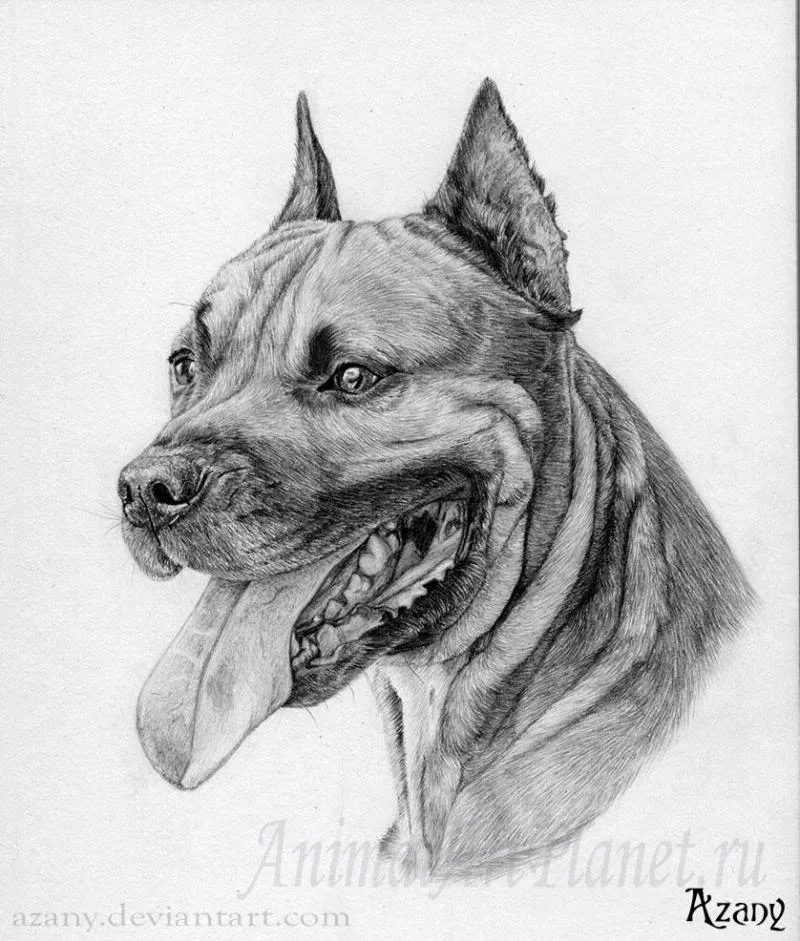
Staffordshire Terrier
+9+24+12215Open stepsShow less
Log in to save your marks. Log in
First, I make a sketch with a 2H pencil, marking all the boundaries between the different tones. Then I lightly clean up the sketch with an eraser so the lines aren’t too dark.
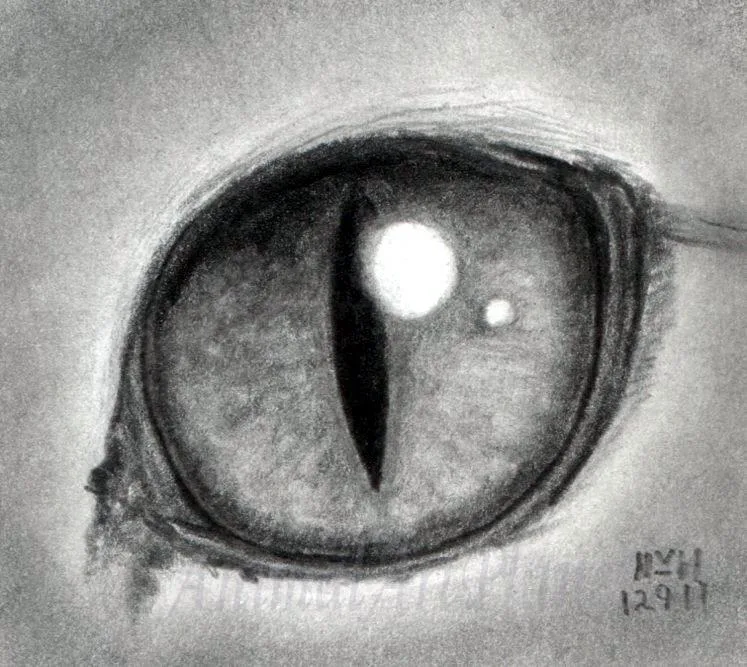
I start shading with the eyes. This is useful because the drawing comes to life right away, and the eyes contain the darkest areas, which give me a reference for the rest of the work.
With a 2H pencil, I mark the direction of the fur around the eye and across the forehead.
I start shading the fur at its darkest point—the eyebrow spot. I use short strokes to show the dog’s short coat.
I work on the fur around the other eye in the same way.
I shade the ear. It is darker, which helps me render the forehead more accurately. I use short strokes. To avoid a harsh edge between the dog and the background, I add a few small stray hairs. When drawing the wrinkles, the key is to make them look three-dimensional. Along with the dark edge, show both shadow and light.
I start working on the other ear with its darkest areas. I also remember to draw the tufts of fur peeking out from behind the cropped ear.
I work on the inside of the ear. First, I shade the whole area evenly with a 2H pencil, making sure individual strokes don’t stand out (but don’t blend the pencil!). Then I switch to an HB pencil to deepen the shadows and add details, again keeping the strokes subtle. I use 2B and 5B pencils to darken the temple and forehead.
I work on the nose. First, I faintly mark the darkest areas, then use softer pencils and circular motions and dots to deepen the shadows. I use the nostrils, which I shaded with a 5B pencil earlier, as a guide. With very short strokes that follow the direction of the fur, I draw the hairs on the bridge of the nose.
I work on the muzzle. First, I apply an even layer of midtone strokes. Then I start deepening the shadows, beginning with the darkest area.
Shading the tongue is similar to shading the ear. I shade it evenly, keeping individual strokes from showing, then add the shadows. I lift the highlights with the sharp tip of an eraser.
I work on the mouth in the same way. A dog’s mouth has many details, especially in this breed, so I start with the darkest areas.
Shade the lower jaw.
Draw the wrinkles on the neck. It’s very important to make them look three-dimensional. Follow the direction of the fur—it curves around the neck, but bends differently in different areas—and move from shadow toward light.
Finish shading the neck. The drawing is complete.







Anet7777
Спасибо за замечательный урок)
Rikk
Мой стафордширский терьер мне 9 лет, оцените)))
cat-vill
Классссс!!! У меня вообще портреты не получаются.
Rikk
Спасибо)) пробуй и получится))
LinaSevil
Шедевр *^* .
Rikk
Спасибо огромнейшее,но это было давно. Но огромное спасибо❤️❤️❤️❤️❤️❤️❤️❤️❤️❤️❤️❤️❤️❤️❤️❤️❤️❤️❤️
ANNISAEVA
Cat-vill,рисунки животных это не портрет,а анимализм
Fekki
Рисовала очень давно и простым карандашом.
tinka
собака-бабака
darik123
как вам? мне кажется не получилось( но я старалась.
iftik
не очень но постарался
vaneu
урок не из легких:)
julia-shmidt
Согласна... А рисунок красивый
julia-shmidt
Я рисовала такого же, только в шляпке
darik123
супер)
Лиза 6 лет.
Папа очень старался ))))
maks2008
Тебе что, всё папа делает? В 6 лет так не рисуют.
Yumi-Chan23
Очень красивый рисунок.Папа твой художник)
Daise
Молодец папа))
Саша
рукржоп мое призвание))
динара
ну